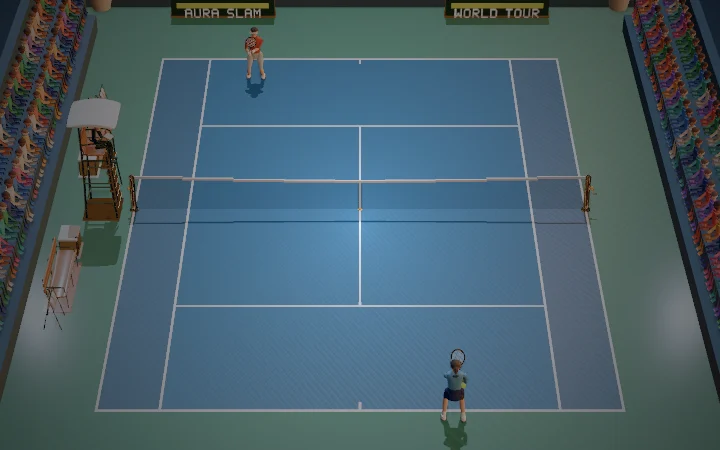
Aura Slam 3D
Championship 3D court tennis.
Articulated 2-bone IK procedural tennis athletes, 6 courts (New York, London, Paris, Dubai, Beach, Moon), Quick Match, and Smash Lab target practice.
Play Aura Slam 3DAura3D 5.5.6 (@aura3d/[email protected]) is a TypeScript engine (MIT declared in package.json) with its own WebGPU-first renderer and automatic WebGL2 fallback for browser 3D scenes and games: a typed, declarative scene API, multi-material procedural modeling, typed GLB/glTF assets with sha256 and provenance, physical PBR materials, a game kit with RuntimeQualityGovernor, Rapier physics, and deploy checks. See it next to the matching three.js app.
These are live public Aura3D 5.5.6 games—not video loops or composited mockups—built 100% with native @aura3d/engine multi-material procedural art on a WebGPU-first runtime with automatic WebGL2 fallback across desktop and Safari/iOS, RuntimeQualityGovernor, mobile touch controls and gesture audio unlock. Rally across 6 world stadiums in Aura Slam 3D, fly over sunset gridlock in Apex Overdrive, race armed Ramjet drones in Thermal Drift, or pilot an autonomous cruiser and supercar fleet across San Francisco in Grid Dispatch.
Articulated 2-bone IK procedural tennis athletes, 6 courts (New York, London, Paris, Dubai, Beach, Moon), Quick Match, and Smash Lab target practice.
Play Aura Slam 3D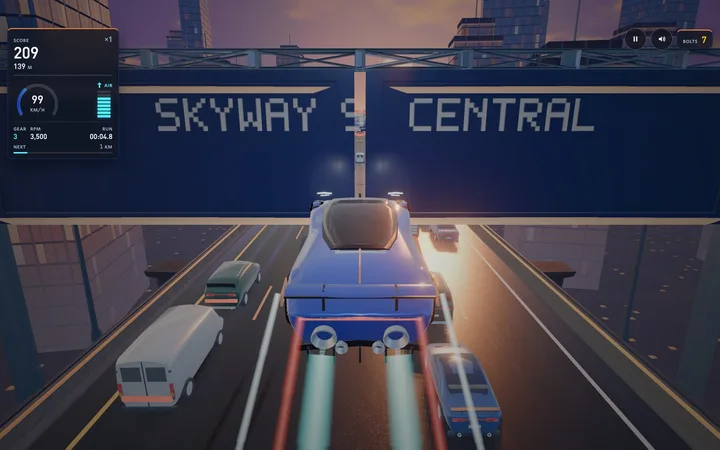
High-speed sunset freeway racer with multi-material procedural interceptors, sky-lane traffic, cold-gas thrusters, barrel rolls and carrier launch ramps.
Play Apex Overdrive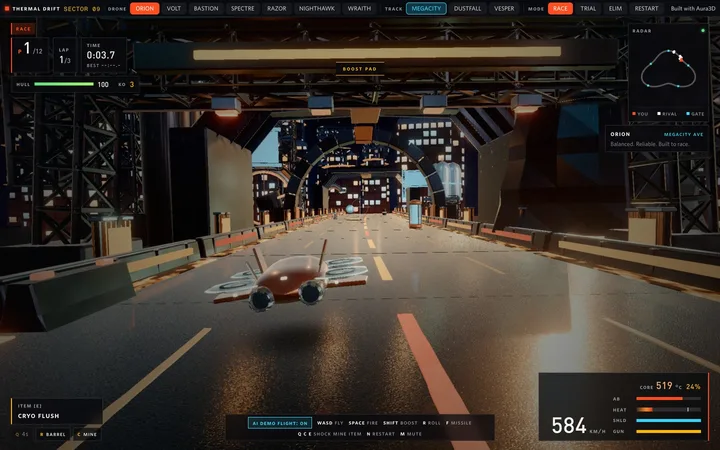
Multi-material procedural cyberpunk circuits and ramjet drones across 3 high-speed tracks, 7 selectable combat drones, thermal overdrive mechanics, and water-mist cooling gates.
Play Thermal Drift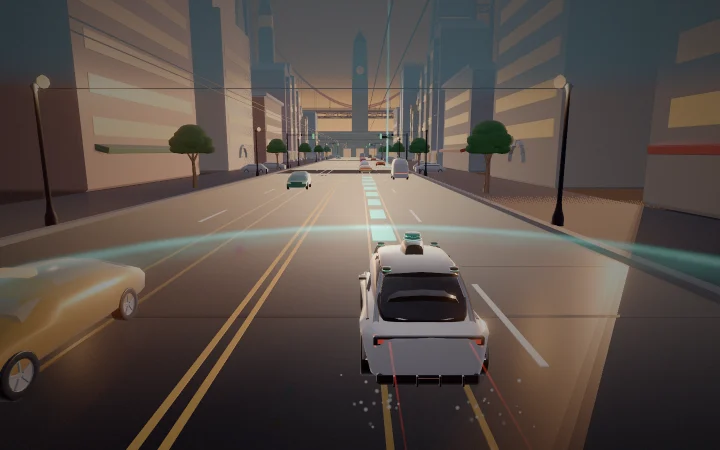
Live 3D San Francisco street grid with multi-material procedural robotaxi and supercar fleet, five driver-assist levels, AI rival traffic, live vector minimap, and five fare dispatch shifts.
Play Grid DispatchA lit, framed, orbitable product in 10 lines, against 38 for the matching three.js app. Typed, hashed, licensed assets, a game kit and agent docs in one install. Every number names its method and its evidence.
Why Aura3D over three.jsAura3D documentation is organized around production tasks: compare against raw Three.js, create an app, describe a scene, register assets, choose templates, use the public API, and prepare a static deployment.
A lit product in 10 lines against 38, the real PBR viewer source side by side, and the migration codemod.
Read comparison Start hereCreate a Vite Aura3D app and give an AI coding assistant the public SDK patterns it needs.
Read guide PromptsGenerate scenes from maintained kits for particles, physics, data, materials, cities, games, and products.
Read guide AssetsRegister GLB and glTF files with the CLI, then import generated asset references in TypeScript.
Read guide TemplatesPick product-viewer, cinematic-scene, or mini-game starters based on what you want to ship.
Read guide APIUse the public @aura3d/engine surface for scenes, models, lights, cameras, materials, and interactions.
Read guide EvidenceUnderstand route, asset, gameplay, visual-QA, package, and hosted deployment proof.
Read guide Claims & limitsSee exactly what Aura3D 5.5.6 proves, what stays route-scoped, and what is not claimed.
Read guide DeployPrepare static output with asset validation, route checks, and production-safe paths.
Read guide